

Why Talent Decisions in Biopharma Require More Than Gut Instinct

Hiring a VP or C-suite leader in biopharma isn't like filling a role. It's a strategic bet with multi-year consequences.
The person you choose will shape your pipeline strategy, define how your teams operate under pressure, and signal to investors and the board what kind of organization you're building. Get it right, and you accelerate. Get it wrong, and the cost shows up in missed timelines, eroded trust, and organizational drag that takes years to fix.
But here's the problem: Most talent decisions get made on incomplete data, competing opinions, and gut instinct dressed up as strategic thinking.
You're choosing between a candidate with deep rare disease expertise but no experience leading at scale — and someone who's built teams across three therapeutic areas but doesn't have the regulatory depth your board is asking for.
Or you're deciding whether to promote the high-performer who lacks enterprise thinking — or bring in an external hire who understands the business but won't have credibility with the science team.
These aren't puzzles with right answers. They're trade-offs where every choice costs you something.
Whether you're hiring a Chief Scientific Officer, a Director of Clinical Operations, or a specialized scientist in a rare therapeutic area — if the decision has consequences that play out over years, this framework applies.
That's why I introduce leaders to the Decision Matrix for talent decisions. It doesn't remove the stakes. It makes your logic visible, so you can defend the call and bring others along.
Why Hiring Decisions in Biopharma Are Especially Complex
Talent trade-offs in biopharma rarely fit clean patterns. You're not just evaluating skills — you're evaluating how someone will perform in contexts that don't exist yet.
Will the CSO with academic pedigree move fast enough when investors are pressing for commercial traction?
Will the CMO with Big Pharma experience adapt to a lean, resourceful team where everyone wears multiple hats?
Will the VP of Clinical Ops who's delivered five successful trials bring the strategic altitude your board expects at this stage?
Add to that:
Therapeutic area depth versus breadth. The candidate with 15 years in rare disease may lack the commercial instinct you need for a pivot.
Technical mastery versus enterprise leadership. The scientist who built your lead program may not be the leader who can scale the organization.
Internal promotion versus external hire. Promoting from within preserves culture but may limit strategic perspective. Bringing someone in adds fresh thinking but risks cultural misalignment.
Speed versus fit. Investors want the role filled. Your team needs someone who won't create more problems than they solve.
Most leadership teams argue these trade-offs in circles. The Decision Matrix forces them into the open.
Before you can evaluate trade-offs, you need the right candidates in the room. Too many biotech leaders default to their network—hiring people they know rather than people they need. If you're still asking "Who do we know?" instead of "Who can take us where we need to go?", read this first: The Executive Hiring Mistake Biotech Leaders Keep Making.
The Cost of Getting Talent Decisions Wrong
Bad hires at the senior level don't just underperform — they create ripple effects that compound over time.
I've seen:
Pipeline delays because a new CSO didn't have the regulatory experience to navigate FDA feedback
Team attrition because a promoted VP wasn't ready for the visibility and decision-making altitude the role required
Board credibility erosion because the hire looked strong on paper but couldn't translate technical depth into strategic communication
Organizational drag because competing priorities and misaligned expectations weren't surfaced early enough
The worst part? These aren't obvious failures. They show up as friction, misalignment, and missed opportunities that take months to diagnose and years to fix.
That's the hidden cost of talent decisions made on gut instinct instead of strategic logic.
How the Decision Matrix Surfaces Hidden Assumptions
The Decision Matrix helps you do three things most hiring processes skip:
1. Force criteria into the open before you evaluate candidates.
What actually matters for success in this role? Strategic altitude? Regulatory depth? Team-building capability? Investor credibility?
Most teams skip this step and let individual preferences drive the conversation. The Matrix makes you decide what success looks like before anyone argues for their favorite candidate.
2. Weight those criteria based on organizational context.
Is therapeutic expertise more critical than leadership experience right now? Does stakeholder influence matter more than cultural fit at this stage?
Weighting forces you to be honest about what the organization needs most — not what you wish it needed.
3. Make the trade-offs explicit.
When you score candidates against weighted criteria, you see exactly what you're gaining and what you're giving up. That clarity changes the conversation from "I like this person" to "Here's why this person gives us the best strategic advantage."
Example: Hiring a Chief Scientific Officer
Let me show you how this plays out.
You're hiring a CSO. The role will define your pipeline strategy, ensure scientific integrity, build investor confidence, and oversee a significant portion of your team. It's a make-or-break decision.
You've got three strong candidates. Each brings unique strengths. None checks every box.
1. Define What Success Requires
Before you evaluate anyone, you define your criteria:
Scientific Expertise (40%): Deep therapeutic area knowledge and a track record in your space
Leadership Capability (30%): Proven ability to build and scale high-performing teams
Stakeholder Influence (20%): Can engage investors, board members, and partners with confidence
Cultural Fit (10%): Thrives in a fast-paced, resourceful environment where agility matters
Notice the weights. You're saying scientific depth matters most, but leadership and influence can't be afterthoughts. Culture matters, but it's not the deciding factor.
2. Score Each Candidate
Now you evaluate your candidates on a 1-5 scale for each criterion, multiply by the weight, and add them up.
Candidate A: Strong therapeutic expertise and technical depth. Less adaptive to fast-paced culture. Weighted score: 3.9
Candidate B: Excellent leadership and cultural alignment. Limited therapeutic expertise and stakeholder credibility. Weighted score: 3.7
Candidate C: Strong stakeholder influence. Lacks therapeutic depth and experience leading large teams. Weighted score: 3.5
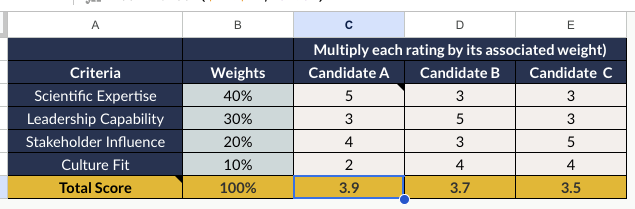
Weighted Decision Matrix for 3 Candidates
The numbers aren’t the decision—they simply surface the consequences of your priorities so you can have the right conversation.
3. What the Scores Tell You
The scores don't make the decision for you. They surface the trade-offs so you can have the right conversation.
If immediate therapeutic expertise is critical — because you're preparing for an FDA meeting or a clinical milestone — Candidate A is your best bet. But you'll need a plan to support their cultural integration and help them adapt to the pace.
If team morale and organizational momentum matter more — because you've had turnover or the team needs a confidence boost — Candidate B delivers better long-term value. You'll need to lean on the collective technical expertise of your team and potentially bring in advisory support.
If investor credibility is your biggest gap — because you're raising a Series B or preparing for a partnership — Candidate C might be worth the trade-off on technical depth. But you'll need strong support around them to offset leadership gaps.
This is strategic thinking. Not spreadsheet optimization.
The Real Power: Alignment and Defensibility
The Decision Matrix does more than help you pick a candidate. It helps you defend the decision when others question it.
Imagine presenting this to your board:
"We evaluated three strong candidates against the criteria that matter most for this role. Candidate A has the edge on therapeutic expertise, which is our highest-weighted priority given the upcoming FDA meeting. We know cultural fit is a gap, and here's our onboarding plan to address it."
That's not a gut call. That's strategic leadership.
And when you build the Matrix with your team or board — not just for them — you're not asking for buy-in. You're co-authoring the decision.
Suddenly, people aren't evaluating your recommendation. They've already shaped it.
For HR and L&D Leaders: This Is How You Scale Strategic Thinking
If you're an HR or L&D leader, the Decision Matrix does double duty.
It helps your executives make better talent decisions. And it models the kind of strategic thinking you're trying to scale across the organization.
When senior leaders use visible frameworks to navigate complexity, they're teaching the next layer how to think — not just what to decide.
That's how you build enterprise leadership capability. Not through workshops. Through tools leaders can use immediately and model for their teams.
Ready to Use This for Your Next Hire?

Click the Image to get your free step-by-step guide to making smart decisions. Email required.
You've got two ways to put this into practice right now.

1. Use the Free Decision Matrix Calculator
Want to test-drive the framework? I've created a calculator you can use immediately to evaluate candidates, compare options, and make the trade-offs visible.
Download the free Decision Matrix Guide here
2. Work Through Your Real Decision with the Custom GPT
If you're in the middle of a high-stakes hire right now — senior leadership, critical technical roles, or any position where the trade-offs aren't obvious — I've built a custom GPT that walks you through this framework in real time.
It helps you:
Clarify what success actually requires for this role
Surface hidden assumptions before they derail alignment
Test your reasoning and build a defensible case
No confidential data required. Free for now.
Email me at angela@justicegroupadvisors.com with "Hiring GPT Access" in the subject line, and I'll send you the link and a quick guide.
I use this exact framework with biopharma executives navigating talent decisions where the stakes show up in board meetings, pipeline timelines, and organizational momentum.
Are you a Chief People Officer or HR leader?
Want practical frameworks to boost your influence, demonstrate business acumen, and make decisions faster and easier? Check out my CPO Coaching page for resources designed just for you.
And don’t miss my CPO Whitepaper: Perspectives from Biotech CEOs, where you’ll discover exactly what CEOs expect from their CPOs—and how you can deliver!
This framework also works for individual career decisions. If you're navigating a job offer or stay-vs-leave choice, read: How to Use the Decision Matrix for Career Decisions
Related Reads



Every organization has moments when the real issue sits unspoken in the room. The leaders who earn lasting respect are the ones willing to name it. “Calling the elephant” isn’t about drama — it’s about surfacing truth so the team can stop circling and start solving what really matters.